
Market, Risk & SWOT Analysis for a Niche Blog – Ultimate Guide
What is a Niche Blog Business?
A niche blog business is a focused online platform that targets a specific audience segment with tailored content. If you’re new, start by learning how to start a profitable niche blog to understand the fundamentals.
Unlike general blogs, niche blogs focus on one topic, which helps build authority and trust with a targeted audience.
Why Business Analysis is Important for Bloggers
To succeed, you need more than just content—you need strategy.
Before launching, it’s important to understand demand, competition, and growth potential. For a strong foundation, read how to build a niche blog step by step and align your blog with clear goals.
Market Analysis for a Niche Blog
The niche blog industry sits within the broader digital content and creator economy, which has grown rapidly due to:
- Increased internet usage worldwide
- Growth of remote work and online learning
- Expansion of digital marketing and e-commerce
Content-driven websites are now a major part of how people:
- Research products
- Learn skills
- Make purchasing decisions
Blogs are no longer “online diaries”—they are media businesses. This creates strong demand for helpful, focused blog content.
Market size and growth of Niche Blog:
- The global content marketing industry is valued in the hundreds of billions of dollars
- Over 600 million blogs exist worldwide
- Businesses that blog generate ~67% more leads than those that don’t

Target Market
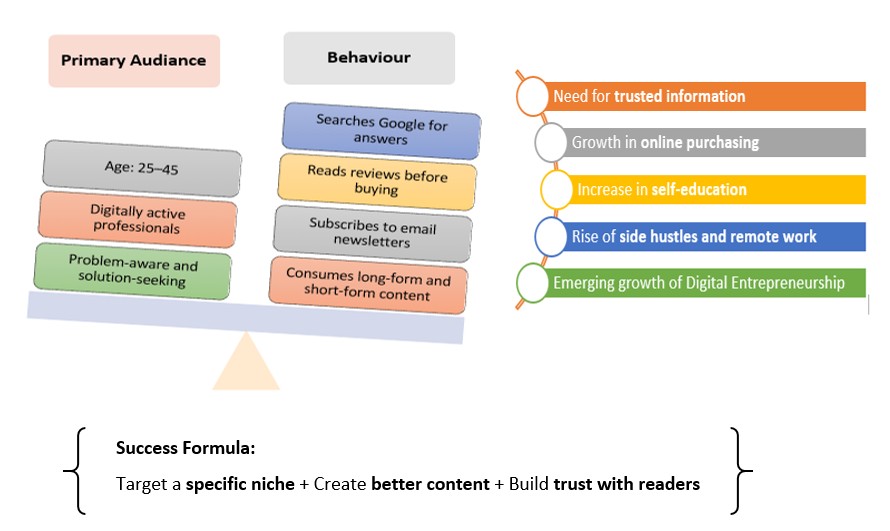
The target market for this niche blog includes digitally active individuals between the ages of 25 and 45. These users regularly go online to find solutions, discover tools, and learn new information. They engage with search engines, social media, and email newsletters on a daily basis. Most importantly, they rely on trusted content before making purchasing decisions.
Several key trends are driving demand in this space. People are looking for information that is both simple and reliable. At the same time, e-commerce continues to grow, making online research more important than ever. Remote work and online learning are also becoming more common, changing how people access knowledge. In addition, more individuals are exploring side hustles and digital businesses to increase their income.
Together, these trends create a strong opportunity for niche blogs that deliver clear, valuable, and targeted content
Impact of Competition and Market Saturation
The competition includes large, well-established blogs, smaller niche blogs, and content creators on social media and video platforms. However, while competition is strong, it also shows that there is high demand for this type of content.
Even so, there are many ways to stand out. For example, you can focus on a specific niche, create helpful and high-quality content, and improve your SEO. In addition, building a strong personal brand can help you gain trust and connect with your audience.
Overall, the market offers solid growth potential. Therefore, if you understand your audience and consistently provide useful and relevant content, you can build a successful and sustainable niche blog.
Types of Competitors
- Authority Blogs
- Established, high traffic
- Strong SEO presence
- Niche Micro-Blogs
- Smaller but focused
- Easier to compete with
- Content Creators
- YouTube, TikTok, newsletters
Competitive Advantage Opportunities
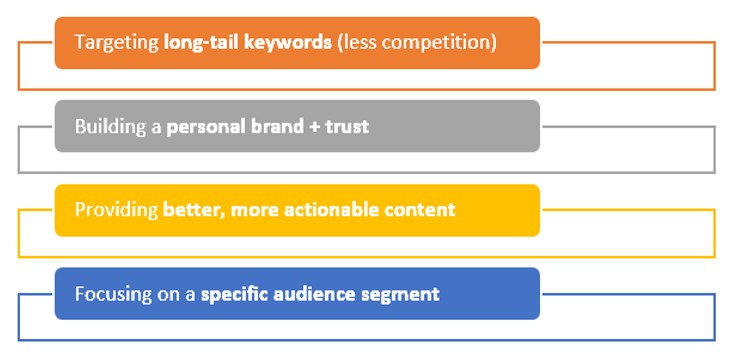
You can win by:
- Targeting long-tail keywords (less competition)
- Building a personal brand + trust
- Providing better, more actionable content
- Focusing on a specific audience segment
Market Trends – Key Trends Shaping the Industry
Risk Analysis for a Niche Blog Business
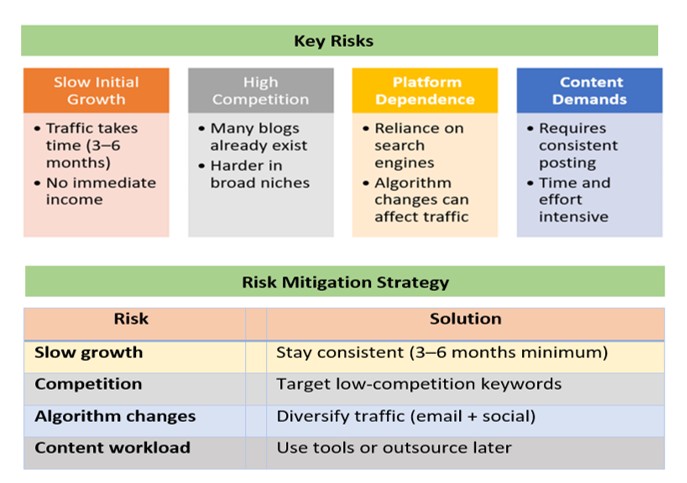
The niche blog business model is low-cost and scalable. However, it also comes with several risks that The niche blog business model is low-cost and scalable. However, it also comes with several risks that must be managed carefully.
To begin with, one of the main challenges is slow growth in the early stages. In most cases, it takes time to build traffic from search engines. As a result, you may not see any income for several months. Because of this, it can affect motivation and make it harder to stay consistent.
In addition, competition in the blogging space is very strong. Many established blogs already rank well and have a large amount of content. Therefore, it can be difficult for new blogs to gain visibility, especially in popular niches.
Moreover, another key risk is dependence on search engines. For instance, if algorithms change, your traffic and rankings may drop suddenly. Consequently, relying on a single traffic source can be risky.
Furthermore, content creation requires ongoing time and effort. You need to publish regularly and maintain high quality. Otherwise, your blog may struggle to grow. At the same time, there is a large amount of similar content online. As a result, standing out becomes more challenging without a clear strategy.
To address these risks, you should focus on low-competition keywords and maintain a consistent content plan. In addition, it is important to diversify your traffic sources, such as using email marketing and social media. Finally, you should continuously improve your content so that it remains useful, relevant, and competitive.
SWOT Analysis for a Niche Blog Business
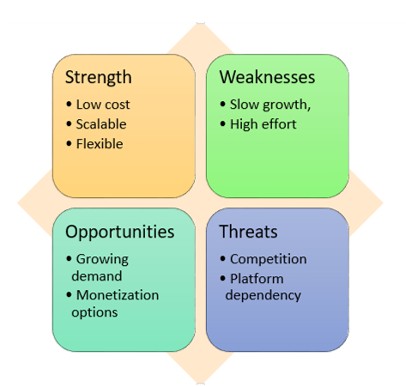
Strengths (Internal Advantages)
- Low startup cost
- Scalable business model
- Flexible (work from anywhere)
- Multiple income streams
- Can become a sellable asset
Once content ranks, it can generate passive traffic and income
Weaknesses (Internal Limitations)
- Slow initial growth
- Requires consistency and patience
- High content production effort
- Dependence on search engine algorithms
Most blogs fail due to inconsistency, not competition
Opportunities (External Growth Potential)
- Growing demand for online information
- Expansion of affiliate marketing and e-commerce
- Ability to build personal brand authority
- Monetization through digital products
Early positioning in a niche can create long-term dominance
Threats (External Risks)
- High competition in popular niches
- Search engine algorithm updates
- Platform dependency (Google, social media)
- Content saturation
The biggest risk isn’t competition—it’s lack of differentiation
Strategic Insight
The niche blog business is not saturated—it’s poorly executed by most people.

Conclusion
Overall, this business shows strong growth potential, even in a competitive market. As highlighted in the market analysis, there is a growing demand for helpful and targeted content. At the same time, the SWOT analysis reveals clear strengths such as low startup costs and scalability, along with valuable opportunities to create multiple income streams.
Therefore, success comes down to a few simple but powerful actions. First, focus on a clear audience. Then, create valuable and relevant content. Most importantly, stay consistent over time. With each post you publish, you build trust. As a result, your blog becomes stronger and more reliable.
In the end, don’t wait for the perfect moment. Instead, start small, learn as you go, and keep improving.
Take the first step today and turn your niche blog into a sustainable and scalable online business.